- Instructor: afrilane
- Lectures: 5
- Duration: 10 weeks
‘ITIL 4’ is the latest addition to the Information Technology Infrastructure Library (ITIL) family. As a flexible IT service management (ITSM) framework, ITIL 4 can be tailored to an organisation’s specific needs and circumstances by providing a common language and best practices for IT service management. This course lays out the fundamentals of this ITSM framework and explains how to apply for ITIL certification to reap its many benefits.
What’s new in ITIL 4?
ITIL 4 still includes those elements from previous versions of ITIL that remain very much fundamental to service management and ITSM. But it also provides a new digital operating model – a basis that’s both practical and flexible, which is designed to help organizations on their digital journey. Plus, the impact of technology on business, and the integration of ITIL best practices with Agile, DevOps, and digital transformation all play a role in the new framework.
The key elements of ITIL 4 are the four dimensions, the guiding principles, the move from processes to practices, and the ITIL service value system (SVS).
ITIL 4 puts service management into a strategic context by looking at ITSM, development, operations, business relationships, and governance holistically. And because ITIL 4 brings these different functions together it has evolved into an integrated model for digital service management.
The ITIL 4 service value system
The service value system is a key part of ITIL 4 and facilitates value co-creation. It shows how all the components and activities of an organization work together for the creation of value. The ITIL 4 service value system has interfaces with other organizations, and thus forms an ITIL ecosystem through which it can create value for those organizations, their stakeholders, and customers.
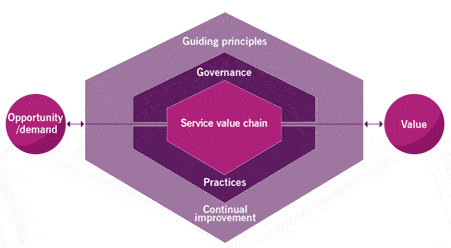
The ITIL service value chain is the centerpiece of the ITIL service value system. It’s a flexible operating model for creating, delivering, and continuous improving of services. There are six key activities within the ITIL service value chain: plan; improve; engage; design and transition; obtain/build; and deliver and support. These activities can be combined in different sequences. Therefore, the ITIL service value chain allows an organization to define a number of variants of value streams, such as the service lifecycle from ITIL v3.
As the ITIL 4 service value chain is flexible, it means that an organization can effectively and efficiently react to changing demands from stakeholders.
The four dimensions
ITIL 4 is all about a holistic approach to service management. Because of this, the framework defines four dimensions that are critical to creating value for stakeholders, including customers.
These four ITIL 4 dimensions are
- Organizations and people – the corporate culture needs to support an organization’s objectives, and the right level of staff capacity and competency.
- Information and technology – within the ITIL 4 service value system, this refers to the information, knowledge, and technologies that are needed for the management of services.
- Partners and suppliers – the suppliers that are involved in the design, deployment, delivery, support, and continual improvement of services and their relationship to the organization.
- Value streams and processes – are the different parts of the organization working in an integrated and coordinated way? This is important to ITIL for the creation of value through products and services.
An appropriate amount of focus needs to go into each of these dimensions such that the ITIL 4 service value system remains balanced and effective.
Would you like to take this course?
Détails
- 5 Sections
- 5 Lessons
- 10 Weeks
- Define the term ‘ITIL framework’ and describe the ITIL 4 versionDefine the term ‘ITIL framework’ and describe the ITIL 4 version1
- Define ‘service management’ and ‘value co-creation’ in the context of organisationsDefine ‘service management’ and ‘value co-creation’ in the context of organisations1
- Explain how products, services, utility, warranty and service relationships workExplain how products, services, utility, warranty and service relationships work1
- Recognise different stakeholders in service managementRecognise different stakeholders in service management1
- Discuss each of the four dimensions of the ITIL 4 framework in detailDiscuss each of the four dimensions of the ITIL 4 framework in detail1